Browse Items (88 total)

Because my map is in German, there is much about it that I still don't understand. That's frustrating on some level, but it has also allowed me to employ the map-studying technique of ignoring text to focus on the visual components of the map and…
This layer includes the 12 illustrations of people from different cultures in the map. The images are grouped by region and labeled with Japanese characters. I believe these depictions represent the desire of the mapmaker to make sense of the…
This layer depicts the fields on the outskirts of the territory of Berlin. They are distinct from the enclosed properties in and around the city, and are set off with horizontal lines. This field terrain is the most peripheral area depicted on the…
Layer1.JPG
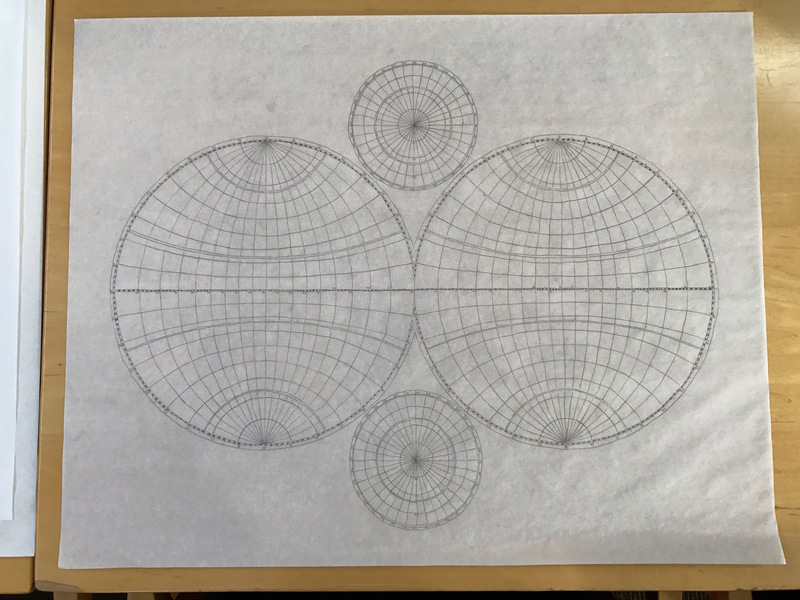
This layer shows the latitude and longitude lines in all four panels of the map (the two hemispheres and the two poles). Included are the latitude and longitude degrees, with the equator clearly demarcated. As a world map, relative sizes and…
Description: Green-blue colored mountains can be seen in almost all continents of the map except for Japan and South America.

Significance: Geographic features, primarily of mountainous regions give an image of how Japanese thought about natural…
This layer is the combined latitude and longitude lines of the map, complete with degrees and other lines of reference. It demarcates the physical system of space measurement that lends credence to the map's representation of area. It also serves as…
The organization of my map, Sekai bankoku Nihon, depends on segmentation of a variety information. The segmentation is facilitated by black lines of various widths that form boxes and borders for text, drawn depictions of people from around the…
Layer one deals with perspective, and what truly constitutes a map within a map. Indeed the perspective drawing beneath the map proper is a map in and of itself, and offers the reader, quite literally, a different angle of 1737 Berlin which was…
What it is:
The pink layer primarily captures the southern landmass that stretches horizontally across the bottom of the map. The map is outlined in a uniform solid black line and presumably traces the coastline/border of the southern landmass. It…
Perhaps the most intrinsic element of a map are the shapes which guide and inform the reader’s perspective. The art of transforming a three dimensional land mass into a two dimensional piece of paper is reliant on orienting the reader’s line of…
Output Formats

atom, dcmes-xml, json, omeka-xml, rss2