Browse Items (88 total)

The North and South Poles, while taking up less space on the map, prove just as integral to the arguments of the map as the East-West Hemisphere split. They are depicted via azimuthal projections in which the distance from a center point is recorded…
Layer2.JPG
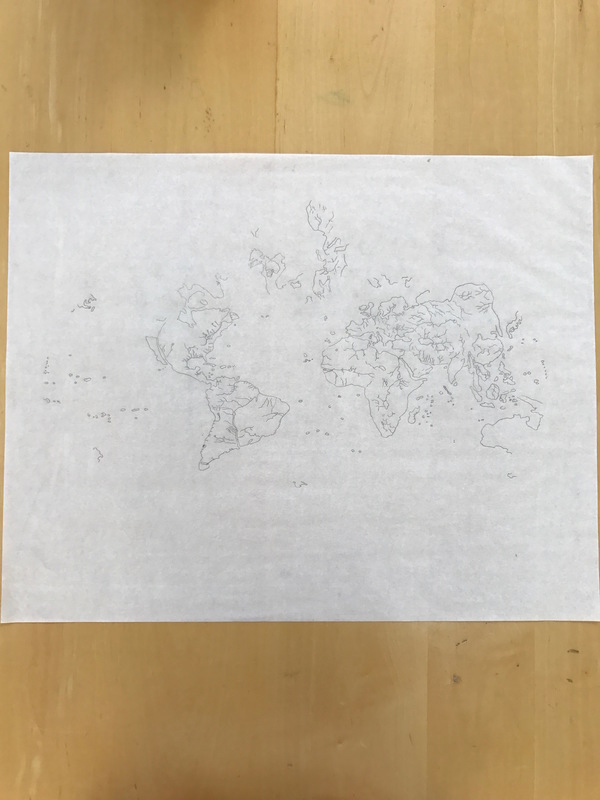
This layer shows the lines on the map corresponding to boundaries between land and water. This includes continental borders, seas, lakes, islands, and rivers. As this is a world map, including a layer for the continents and oceans was essential, yet…
This layer features colored depictions of the continents included in the map. I chose this layer to focus on the Japanese perspective of the globe, which includes very basic depictions of the continents. I noticed nearly every land mass, including…
This layer depicts the fortifications that mark the boundaries of the territory of Berlin, and which focus the viewer's attention on the center of the map. The northern boundary of the city appears to be a walled fortification, which gives way to a…
Description: Red bodies of water, 「西紅海」「東紅海」can be seen to the right of Libya and running down North America out into the Pacific Sea (which is not shown on the map), respectively. 「西南海」(Southwest Sea)「大南海」(Big South Sea)「東南海」(Southeast Sea) are all…
One of the key purposes of this map was to provide the reader(s) with a plan for where to place specific military personnel and supplies/equipment upon landing on the beach. This information is conveyed through symbols, numbers, and acronyms, which…
The dominant features, and therefore first layer of this map are the various water obstacles. The water obstacles are denoted in dark blue and frame the map on the north, west, and east sides. The water must be the first layer, as the rest of the…
This layer shows the map reader(s) where bodies of water are located. Knowing the location and layout of water was important for at least two reasons: (1) it indicated where barriers and entryways to accessing land further inland existed, and (2) it…
Perhaps the most intrinsic element of a map are the shapes which guide and inform the reader’s perspective. The art of transforming a three dimensional land mass into a two dimensional piece of paper is reliant on orienting the reader’s line of…
What it is:
The pink layer primarily captures the southern landmass that stretches horizontally across the bottom of the map. The map is outlined in a uniform solid black line and presumably traces the coastline/border of the southern landmass. It…
Output Formats

atom, dcmes-xml, json, omeka-xml, rss2