Soviet Military Mapping: L-19 Series Northern Maine Soviet Map Trends and Anomalies
John Davies, Alexander Kent devoted much of their attention to the UK and to the very detailed cityscapes. Davies, in a podcast describing the book, suggested that having a degree of “hometown” knowledge of a particular area can help a scholar find interesting characteristics in the Soviet maps. Consequently, I opted to analyze the 1978 Soviet maps of northern Maine (“Generalnii Shtab”, L-19-11 (Presque Isle), 1:200,000, 1978; L-19-2 (Fish River), L-19-4 (Bangor)), to see what differences lie between it and USGS maps of similar scale and year. 1:200,000 Soviet Maps of the New England states can be found in the Harvard Map Collection, while the USGS website, https://ngmdb.usgs.gov/topoview/ is very useful for finding historical maps of the US.
Researching these maps can feel very daunting, given the shear amount of data available. However, I found it useful to narrow my focus to just my hometown area and then even further, to a few key places. Knowledge of Cyrillic writing, while not necessarily vital to exploring these maps, helps significantly in determining differences between the USGS and Soviet maps. However, my knowledge of Russian did not assist in finding most of the peculiarities. In fact, reading the text often belabored my efforts to uncover abnormalities. Instead, I followed Marion Newbigin’s advice in Ordnance survey maps: their meaning and Use of turning the maps upside down and ignoring the text. In this manner, I compared the maps, side by side and discovered certain trends in the Soviet Maps.
Trend 1: Soviet Maps modeled after the USGS 1:250,000 and 1:24,000 Maps from 1930s- 1960s.
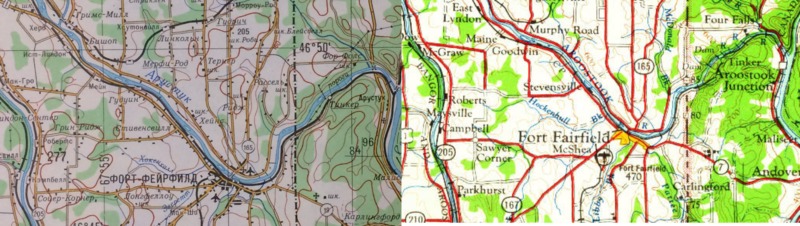
Almost all the nomenclature and labeling on the Soviet maps could overlay on top of the USGS maps from the 1960s. Rivers, lakes, roads, and town names are located in almost identical spots on the maps. The two maps appear almost identical in their place name labeling, with the noteworthy exception of the “Лонгфеллоу шк.” (Longfellow School) that appears below the word “Форт Файрфилд” (Fort Fairfield). Some of the labeling diverges, but usually only when information from a previous USGS map is included on the Soviet version. For instance, the Soviet maps include all of the individual school names, whereas the USGS maps from the 1960s exclude this information. Looking at earlier versions of USGS maps, including the 1933 map of Fort Fairfield, the school names are listed.
Two assertions can be formed with these examples: 1). The Soviets used the USGS maps to base their own versions. 2). Data came from very early sources, including USGS 1930 era maps. In various research websites, including John Davies’, emphasis is made on the differences in detail between host nation maps and the Soviet versions of the same scale and era. A possible explanation appears to be that the Soviets used earlier map versions and compiled the data into their own.
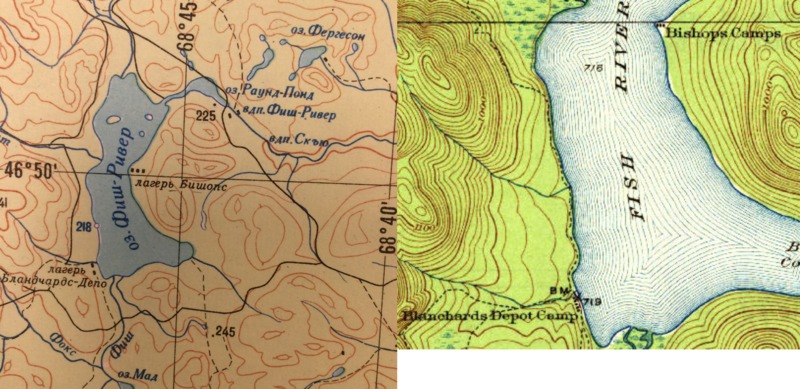
Why label the schools? It is possible that they thought that they could be useful landmarks. But they also chose to label more mundane items, with little apparent value to navigation or cultural understanding. As shown, the Soviet map of Fish River Lake in Northern Maine captures the names of the owners of fishing and hunting camps. From the available topographic maps on the USGS website, it appears that USGS stopped depicting this information in 1935.
Two justifications for incorporating this information appear plausible: 1). The Soviets possessed earlier versions of the maps, the information was available, so why not include it? This follows Alexander Kent and Greg Miller’s theory of the Soviet maps serving as a repository of available information- a 1980s version of Wikipedia. 2). Ownership of these camps denoted wealth and therefore these names represented important figures in the community who could be useful once the Soviets took charge, in line with John Davies belief that the Soviets wanted the maps to use for the inevitable take-over of the world.
Trend 2: Omissions and mistakes
1). Tinker Dam omission
Built in 1923, Tinker Dam sits on the border of the US and Canada on the Aroostook River. The Soviets correctly labeled the area, but it appears that they either thought “Tinker” meant a small village or the name for that particular part of the river. The Soviets labeled the ¼ inch lines as пароги, or rapids, and make no mention of the dam. This is quite surprising, especially if you consider the emphasis that they placed on other public works, including electrical and hydrological engineering projects, for their own eventual use. As John Davies asserts, the Soviets mapped these areas not to plan for an invasion necessarily, but instead to have a thorough understanding of the lands that they believed they would eventually rule.
2). Military Installations
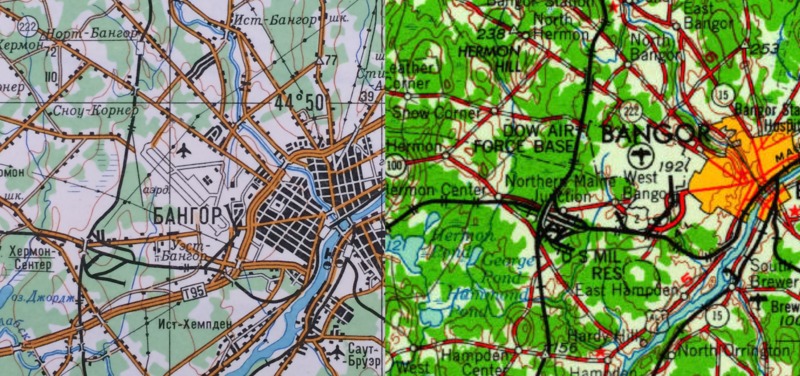
Throughout northern Maine, including in the small towns of Limestone, Presque Isle and Bangor, the US military maintained garrisons and Air bases. While the Presque Isle base went out of commission in the early 60s, the Bangor Air Field, formerly known as Dow Air Force Base, continues to operate. During the 70s and 80s, it served as an important refueling hub for cross-country military travel. In the 1963 USGS map, both Dow and another Military Reservation are clearly depicted in the 1: 250,000 scale map. However, the Soviets do not denote the military affiliation of the airfield, but do depict the runways and more detail inside of the perimeter area. There is also no mention of the southern military reservation seen on the USGS map.
Loring Airforce Base Nomenclature Omission
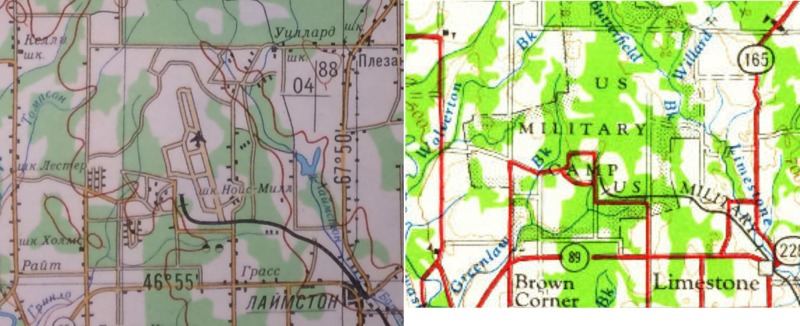
This is perhaps the most shocking omission, given the nature of the former Loring AFB. At one time, Loring was the largest air base in all of Strategic Command, home to B-52s and nuclear capable weapons. Located on the far eastern portion of the US, it sat closet to the western Soviet Union than any other US mainland airbase, making it strategically important.
Despite its significance, the Soviet map version does not label Loring as a military installation. In other, more detailed maps, they labeled air bases as Аеродром ВВС, like in this map of Hanscom Air Force Base. As seen from the detail in their map, the Soviets obviously knew of the base’s existence and likely used satellite imagery to update their map, giving an accurate depiction of the runway system on Loring, along with buildings not depicted on the USGS map. Unlike the other abnormalities, no earlier USGS versions give greater detail to this area. This demands further research, but the Soviets either had a secondary host-nation source of imagery or produced their own.
Why would the Soviets not label military installations on 1:200,000 maps? Lack of space may be one explanation, given the small scale. However, they chose to include minute details, like names of schools and logging camps; in places like rural Maine, the maps are far from overcrowded with other details. Another explanation could be that the Soviets, given their dictatorial management of their own territory, may not have found the need to label an airfield as “military”. Everything could be militarized in the Soviet Union.
This example does not fully explain the reasoning. A foreign force would want to know the whereabouts of military personnel, not to mention the equipment and armament stored in these facilities. The Soviets may have created more secret maps, drawn to a larger scale, and clearly depicting the military nature of these facilities. If this is the case, who was the target audience for the 1:200,000 maps and why would military installations not be key terrain, clearly labeled?
Understanding all the Soviet system of mapping takes more than analyzing a few examples, but in just three sheets, I uncovered some interesting trends and even more unanswered questions. With such a potential treasure trove of information, the maps need to be categorized and accessible for further research.